
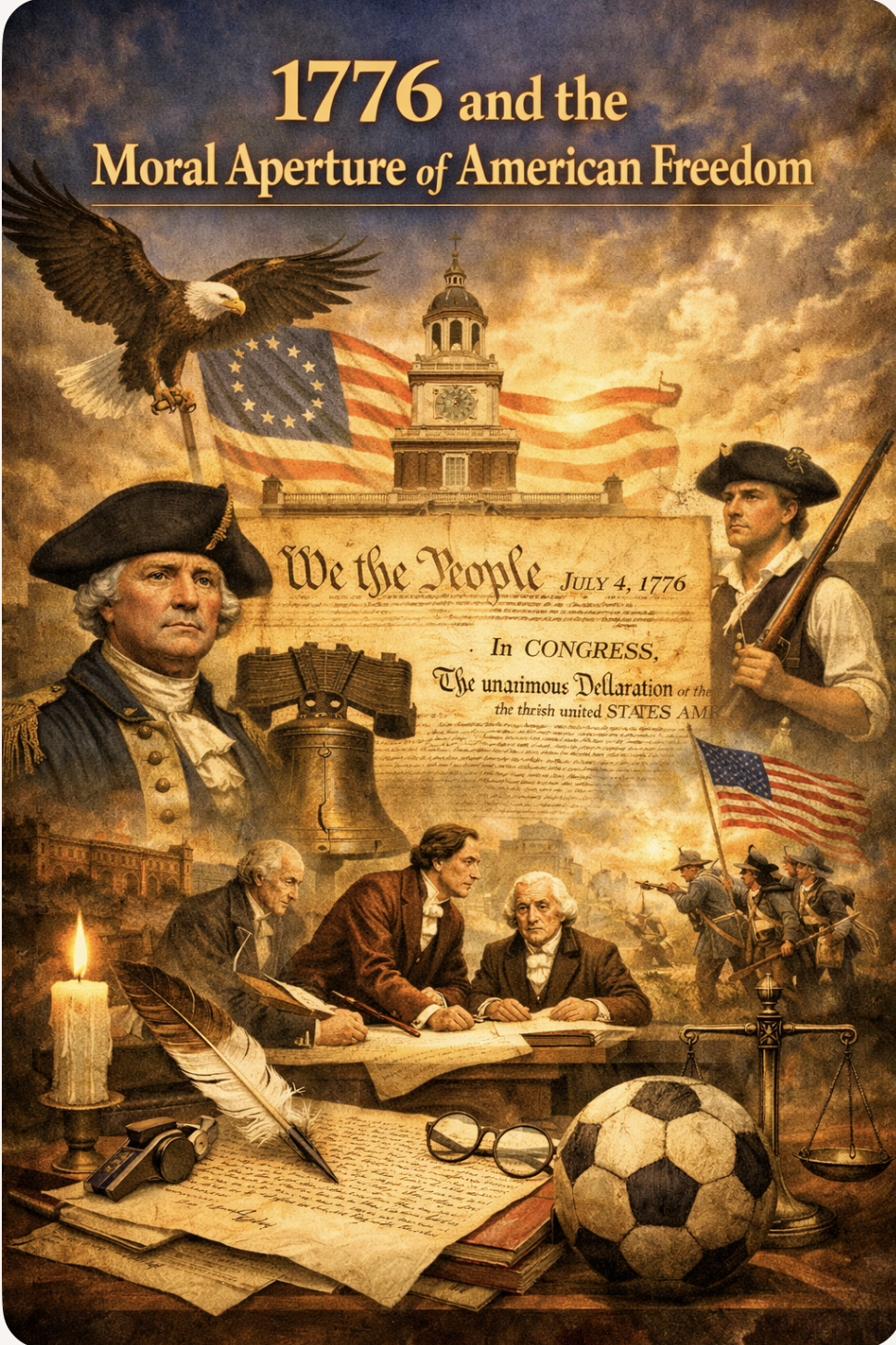
America at 250 and the Unfinished Business of Independence
Celebrating Without Myth-Making
On July 4, 2026, the United States marks the 250th anniversary of the Declaration of Independence. The occasion invites celebration, but serious celebration cannot be mere ceremony. It must ask what, precisely, is being celebrated. If the answer is that America was morally complete in 1776, the answer is false. If the answer is that America was born without contradiction, the answer is not simply false; it is evasive. But if the answer is that 1776 created a moral and political framework through which later generations could force the republic to answer for the contradiction between its professed ideals and its actual exclusions, then the celebration becomes intellectually defensible and morally serious.
The strongest point is not that American Independence abolished slavery. It did not. Nor is the strongest claim that abolition became inevitable once the Declaration was adopted. It did not. The defensible point is: American Independence opened an indispensable avenue within the American political tradition for later freedom projects, including abolition. The word “indispensable” must be handled carefully. It does not mean that no moral argument against slavery could have existed without 1776. Christian universalism, natural law, humanitarian reform, enslaved people’s resistance, and transatlantic abolitionism all supplied powerful antislavery resources. The point is narrower but stronger: within the American tradition, 1776 supplied the uniquely internal standard by which slavery could be condemned as a violation of America’s own public theory of legitimacy.
The Declaration as an Internal Standard
The Declaration of Independence asserted three propositions that would later become deeply destabilizing to regimes of domination that claimed legitimacy under the American creed. First, human beings possess equal moral standing. Second, legitimate government derives its authority from the consent of the governed. Third, when government becomes destructive of fundamental rights, the people retain the right to alter or abolish it. These propositions appear in the Declaration’s central paragraph, where equality, unalienable rights, consent, and political alteration are joined into a single theory of legitimate government.
The genius of 1776 was not that the founding generation fully obeyed its own premises. It did not. The genius was that the premises, once publicly announced, became available for use against the exclusions the founders tolerated, rationalized, or protected. The Declaration created a standard that exceeded the moral imagination of many who issued it. Its obligation set was larger than its founding coalition. That is why the text mattered beyond the intentions of its signers. The signers could control the immediate political settlement; they could not permanently control the future meaning of the principle they had placed at the center of American legitimacy.
Why “Indispensable” Requires Immanence
The distinction between external indictment and immanent indictment is the key to the argument. External indictment condemns slavery by appealing to a premise outside the slaveholding republic’s own self-description. A Christian abolitionist might say slavery violates the universal fatherhood of God. A natural-law theorist might say slavery violates the moral law prior to positive law. A humanitarian reformer might say slavery violates human sympathy and civilized conscience. These arguments are powerful. But each requires the slaveholder, the legislator, or the nation to accept an external premise.
The 1776 argument works differently. It says to America: you have already declared the rule by which you must be judged. You have already stated that human beings possess rights, that government rests on consent, and that political authority becomes illegitimate when it destroys the ends for which government exists. Therefore, slavery is not simply wrong by some outside doctrine. It is wrong by America’s own announced criterion of legitimacy.
That is what makes 1776 indispensable as an avenue. Other moral traditions could condemn slavery. Only the American founding creed could make slavery appear as a contradiction internal to American public identity. Other arguments could say, “You are wrong.” The 1776 argument could say, “You are false to yourself.” That is a structurally different form of accusation. It converts abolition from a plea for benevolence into a demand for national consistency.
Independence Did Not Cause Abolition
This distinction also protects the argument from a crude causal reading. A simplistic account would say that Independence directly produced abolition. That claim is historically indefensible. Abolition required Black resistance, abolitionist organization, sectional conflict, Civil War, constitutional amendment, federal enforcement, and political reconstruction. In that sense, 1776 was not a sufficient cause of abolition. It did not mechanically deliver emancipation. It did not prevent slavery’s expansion. It did not prevent constitutional compromise with slavery.
But it did provide the internal moral architecture through which abolitionists, free Black thinkers, enslaved people, Union soldiers, Reconstruction statesmen, suffragists, civil-rights activists, and later constitutional reformers could prosecute America by America’s own standard. That is the avenue. It was indispensable not because abolition could not be imagined by any other moral vocabulary, but because no substitute could perform the same immanent function within the American political tradition.
Slavery’s Expansion Inside a Republic of Liberty
The numerical record proves why this distinction is necessary. In 1790, the first census counted 3,929,214 people in the young United States. Of that population, 697,624 were enslaved. By 1860, on the eve of the Civil War, the enslaved population had risen to 3,953,760. That is not a marginal contradiction. It is a national contradiction.
Between 1790 and 1860, the enslaved population grew to more than five and a half times its 1790 size. The enslaved share of the total population fell from roughly 17.8 percent in 1790 to roughly 12.6 percent in 1860 only because the total population grew even faster, reaching 31,443,321 by 1860. In absolute terms, slavery expanded dramatically inside the republic founded in the name of liberty.
This fact defeats any sentimental reading of 1776. The Declaration did not prevent the growth of slavery. The American republic did not simply inherit slavery as a static residue from colonial life; it developed, protected, and expanded a slaveholding order for nearly nine decades after Independence. Any argument that celebrates 1776 must begin by admitting this.
The Constitution’s Compromises with Slavery
The Constitution deepened the contradiction. The Constitution of 1787 did not use the word “slavery,” but it accommodated slavery through institutional design. Article I, Section 2 counted three-fifths of “all other Persons” for representation and taxation. Article I, Section 9 prevented Congress from prohibiting the importation of enslaved persons before 1808. Article IV, Section 2 required the return of persons “held to Service or Labour” who escaped into another state.
These provisions did not simply tolerate slavery as a local practice. They embedded slavery into the allocation of representation, the timetable of federal power, and the obligations of states toward one another. The American founding therefore contained two facts: a Declaration that announced a universal theory of political legitimacy, and a Constitution that accommodated slavery inside the operating machinery of the new republic.
Between Sentimental Nationalism and Cynical Negation
This is why any serious celebration of America at 250 must reject both sentimental nationalism and cynical negation. Sentimental nationalism says the founding was pure. Cynical negation says the founding was only hypocrisy. Both readings are inadequate. The founding was neither pure nor empty. It was morally divided. It announced a universal principle and then built institutions that denied the principle to large categories of human beings.
But a contradiction of that kind is not inert. It creates pressure. It creates a standard by which the republic can be accused, judged, and forced to revise itself. A regime that never declares universal rights can oppress without internal contradiction. A regime that declares equality, consent, and natural rights while permitting slavery creates an argumentative weapon against itself. The enslaved, the formerly enslaved, abolitionists, and later civil-rights movements could say to America: you have already stated the rule; now obey it.
The British Counterfactual and the Two Axes of Judgment
The hardest anti-sentimental objection is the British counterfactual. Britain abolished slavery across much of its empire through the Slavery Abolition Act of 1833, with compensation to slaveholders and with a coercive apprenticeship system that delayed full freedom for many formerly enslaved people. Compared with that timeline, American Independence may appear not as a route to abolition but as an event that helped entrench slavery for longer than might have been the case had the colonies remained within the British imperial system.
That objection is serious, but it operates on a different axis. It concerns material timing: whether Independence delayed abolition relative to a British imperial path. The argument here concerns normative resources: whether 1776 created a distinctive internal standard within American political life by which later freedom movements could indict the nation in its own name. The British counterfactual may weaken a triumphalist story about Independence accelerating abolition. It does not defeat the narrower claim that, once the United States existed as an independent republic, the Declaration furnished the indispensable immanent avenue by which slavery could be condemned as a violation of America’s own professed creed.
This distinction matters. An argument can be materially delayed and normatively indispensable at the same time. The American path to abolition was slower, bloodier, and more constitutionally compromised than any honest patriot should wish. But the internal framework through which abolition became an American constitutional demand was still rooted in the founding principle of equal rights and legitimate consent.
Black Agency in the Revolutionary Era
Black Americans were not passive beneficiaries of this process. They were agents inside it from the beginning. During the American Revolution, Black Patriots served the American cause as soldiers, sailors, teamsters, cooks, stewards, nurses, and camp followers. Estimates commonly place the number of Black people who served the American cause in the Revolution between 5,000 and 8,000.
Their service made the contradiction concrete. People denied full liberty helped secure the political independence of a republic speaking in the language of liberty. They fought not only in the American struggle against Britain but also in the hope that the language of liberty might become real for themselves and their families. The Revolution was therefore not only a white colonial revolt against imperial administration. It was also a contested freedom field in which subordinated people saw an opening to convert imperial crisis into claims for personal and collective liberation.
The Declaration Exceeded Its Founders
That is why the Declaration’s language matters beyond original intent. Its words exceeded the social imagination of many who signed it. The text created a horizon larger than the coalition that produced it. This is the live wire of the argument. The Declaration generated a political standard whose implications could be developed by later agents who were not fully included in the original political community.
This is how moral propositions often work in history. A people may announce a principle for a narrow purpose, only to discover that the principle contains implications wider than the announcing class intended. Once made public, the principle becomes available to outsiders, dissenters, excluded persons, and future generations. They can ask whether the society that proclaimed the principle is prepared to live under it.
Frederick Douglass and the Logic of Self-Indictment
Frederick Douglass understood this better than almost anyone. In his 1852 address, “What to the Slave Is the Fourth of July?” Douglass did not offer cheap reverence. He indicted the hypocrisy of a slaveholding republic celebrating liberty.
Douglass’s method was not anti-American in the simple sense. It was a deeper form of constitutional patriotism. He used America’s professed standard against America’s actual practice. He did not need to ask the republic to become something wholly foreign to itself. He demanded that it answer to the principle it already celebrated.
This is also why Douglass’s own intellectual movement matters. He began closer to the Garrisonian position, which treated the Constitution as fatally complicit in slavery and therefore morally corrupt at its root. William Lloyd Garrison famously denounced the Constitution as “a covenant with death” and “an agreement with hell.” But Douglass later moved away from that position toward an antislavery constitutional reading. That migration is analytically important, though not conclusive. It suggests that Douglass came to see strategic force in forcing America to answer to its own public commitments. But it does not, by itself, prove that immanent critique was causally stronger than external critique in an independently measurable sense.
The contrast should therefore not be overstated. External critique mattered. Christian abolitionism, natural law, humanitarian reform, and Garrisonian repudiation all supplied moral energy to the antislavery cause. But Douglass’s mature strategy reveals the distinctive form of immanent critique: it did not simply condemn America by an outside standard; it forced America to stand trial under its own founding proposition.
Dred Scott and the Fragility of Immanent Critique
But immanent critique has a weakness that must be examined. The same national creed that supplies the weapon of indictment can also be reinterpreted by those who control legal and political authority. The target of the critique can try to restrict the meaning of its own commitment. It can say, in effect: yes, we declared equality and rights, but those principles were never meant to include you.
That was the significance of Dred Scott v. Sandford in 1857. Chief Justice Roger Taney did not simply defend slavery as a social institution. He attempted to close the immanent avenue from inside by claiming that Black people, whether enslaved or free, were not included within the political community contemplated by the Constitution. The point is not that there existed at 1776 a fully determinate obligation set that Taney later narrowed. That would beg the question. The point is that the founding language fixed a vocabulary of equality, rights, consent, and legitimacy while leaving its extension contested. Taney’s opinion was an authoritative attempt to settle that contested extension in the exclusionary direction.
John C. Calhoun’s “positive good” defense of slavery had already moved in this direction politically and philosophically. Calhoun did not simply apologize for slavery as a regrettable necessity. He attempted to reconstruct the moral meaning of the American order so that slavery could be treated as compatible with, or even beneficial to, republican stability. Dred Scott then supplied the judicial version of the same project: not simply delaying the payment of the American promise, but contesting the denomination of the promise itself.
This is the essential fragility of immanent critique. External critique can be rejected, but it cannot be redefined by the slaveholder on its own terms in quite the same way. If one says slavery violates natural law, the defender of slavery may deny natural law, but he cannot claim final national authority over what natural law itself must mean. Immanent critique is different. Because it works through the nation’s own creed, it is vulnerable to the nation’s own institutions contesting and restricting the creed’s reach.
This does not defeat the argument. It deepens it. The immanent avenue was indispensable, but it was not self-protecting. It had to be kept open against adversarial reinterpretation. The American freedom struggle was therefore not a struggle to invoke the Declaration. It was also a struggle over who had authority to define the Declaration’s extension. Excluded groups expanded the meaning of the creed; incumbent regimes tried to restrict it. The founding standard did not adjudicate that contest by itself. Power, war, constitutional amendment, political organization, and federal enforcement did.
Dred Scott therefore clarifies the true structure of the argument. Immanent critique is not unconditionally stronger than external critique. It is stronger only when the interpretation of the creed can be held open against exclusionary closure. Holding it open is what cost a civil war, emancipation by military necessity, and the Reconstruction Amendments. The freedom project required not only the moral aperture of 1776, but also the institutional force needed to prevent that aperture from being closed from within.
The Identification Boundary
There is, however, a limit to what the historical evidence can prove. The essay is not claiming that immanent critique was causally more efficacious than external critique in a cleanly identified sense. That claim would require holding enforcement power constant while varying the frame of moral argument. History does not give us that experiment.
Douglass’s movement from a more Garrisonian position toward an antislavery constitutional reading is suggestive, but it is not dispositive. His migration occurred as he moved more fully into electoral and constitutional antislavery politics, as a political coalition capable of acting within the constitutional order was coming into being. That means the observed shift is consistent with two interpretations. It may show that Douglass found the immanent frame intrinsically stronger. But it may also show that once one decides to fight inside the constitutional order, the immanent frame becomes the natural language of that struggle. The frame choice is therefore endogenous to the enforcement environment.
The honest claim is not that the marginal causal product of immanent critique can be isolated from war, party-building, constitutional amendment, and federal enforcement. It cannot. The stronger and cleaner claim is typological: the Declaration supplied a consistency form that external frames could not supply. External critique could say slavery violated God, nature, reason, or conscience. The 1776 frame could say slavery violated America’s own announced proposition. That difference is real, but it is a difference in the form of demand, not an independently measured causal effect.
Thus, the mature thesis is this: the immanent frame was indispensable as the internal standard around which the American freedom struggle could be organized, constitutionalized, and enforced. Its historical efficacy, however, was inseparable from the power that held its interpretation open. The Declaration supplied the vocabulary of indictment; political struggle determined its extension; institutional power determined whether the indictment would bind.
Universal Language, Restricted Application
That is the essential logic of the American freedom tradition. The country’s excluded populations have repeatedly forced the republic to confront the gap between universal language and restricted application. America announced principles that spoke in general terms: persons have rights; governments require consent; arbitrary domination violates legitimacy. Yet the original political community applied those principles narrowly, largely to white men and, in many jurisdictions, to men with property.
Over time, the history of American freedom became the struggle to expand the circle of those recognized as full bearers of the rights the founding language already implied. This was not automatic progress. It was contested expansion. The principle did not enforce itself. Its extension was not fixed by the text alone. But it gave excluded groups a way to transform grievance into rights claim, and rights claim into constitutional demand.
The Civil War as the Test of 1776
The Civil War became the crucial test of whether the Declaration’s universal language would remain rhetorical or become constitutional. Lincoln’s greatness lay partly in his insistence that the Union could not be understood apart from the proposition announced in 1776. In the Gettysburg Address, he located the nation’s birth “four score and seven years” earlier, meaning 1776, and described it as “conceived in Liberty” and dedicated to the proposition that all men are created equal.
Lincoln’s formulation was not antiquarian. It was a constitutional reinterpretation of the war. The war was not simply about territorial union; it was about whether a republic founded on equality could survive while tolerating human bondage. Lincoln thereby made 1776 the interpretive key to the war’s moral meaning. The Union cause became, at its highest level, a struggle over whether the founding proposition would be emptied by slavery or vindicated through emancipation.
Emancipation as Inflection Point, Not Endpoint
The Emancipation Proclamation was an inflection point, not the endpoint. Issued on January 1, 1863, it declared enslaved persons in rebellious areas to be free. But it was limited. It applied to states in rebellion, left slavery untouched in loyal border states, exempted some areas under Union control, and depended on Union military victory.
Yet the proclamation transformed the war’s meaning. After January 1, 1863, every advance of federal troops expanded the practical domain of freedom. The proclamation also authorized Black men to enter the Union Army and Navy, allowing the liberated to become liberators.
Black Military Service and Citizenship
The data on Black military service during the Civil War makes that phrase more than metaphor. By the end of the war, roughly 179,000 Black men, about 10 percent of the Union Army, served as soldiers, and another 19,000 served in the Navy. Nearly 40,000 Black soldiers died, most from infection or disease.
This is not a marginal footnote to emancipation. It is central to the political economy of abolition. Black service increased Union manpower, strengthened the moral legitimacy of the Union cause, and made citizenship claims harder to deny. Once Black men fought under the national flag, the republic faced a sharper version of its own contradiction: could men who risked death for the Union be denied standing within the Union?
The Thirteenth Amendment and Constitutional Abolition
The Thirteenth Amendment converted wartime emancipation into constitutional abolition. Passed by Congress on January 31, 1865, and ratified on December 6, 1865, it abolished slavery in the United States. This was the first great constitutional correction of the founding contradiction.
But abolition alone was insufficient. A formerly enslaved population could be free in the negative sense and still lack citizenship, equal protection, political power, property, security, and institutional standing. Thus, the American freedom project required not one amendment but a Reconstruction architecture.
Reconstruction and the Repair of the Immanent Avenue
The Fourteenth Amendment, ratified in 1868, extended citizenship and constitutional protections to formerly enslaved people. Its central provisions granted citizenship to all persons born or naturalized in the United States, prohibited states from depriving persons of life, liberty, or property without due process of law, and required equal protection of the laws.
The amendment did more than add a new constitutional principle. It repaired the interpretive failure exposed by Dred Scott. Taney had attempted to close the American creed by denying that Black people belonged within its political and constitutional domain. The Fourteenth Amendment reopened that domain by constitutionalizing birthright citizenship and equal protection. It transformed what had been morally implied by the Declaration into a firmer constitutional command. By writing the creed into the Constitution itself, the Fourteenth Amendment fused the two internal standards — creed and compact — that Dred Scott had played against each other, closing the interpretive seam Taney had exploited.
The Fifteenth Amendment, passed by Congress in 1869 and ratified in 1870, prohibited denial of the vote on grounds of race, color, or previous condition of servitude. Together, the Thirteenth, Fourteenth, and Fifteenth Amendments did more than abolish slavery. They attempted to reconstruct the constitutional meaning of personhood, citizenship, equality, and political membership.
This is why Reconstruction is central to the thesis rather than an afterthought. If 1776 created the moral aperture, Reconstruction attempted to secure it against contraction. The Reconstruction Amendments were not simply consequences of the founding creed. They were institutional repairs to the founding creed’s vulnerability. They made explicit what Dred Scott had tried to deny: that the American proposition could not be confined permanently to the narrow domain preferred by those who originally controlled the republic.
Jim Crow and the Limits of Normative Obligation
Still, the American record again refuses simple celebration. The Fifteenth Amendment did not secure full democratic participation for Black Americans for the next century. African Americans exercised voting rights and held office in many Southern states during Reconstruction and its immediate aftermath. But by the late nineteenth and early twentieth centuries, literacy tests, grandfather clauses, poll taxes, intimidation, and racial violence were used to disfranchise Black citizens across much of the South.
This history does not refute the indispensability of the 1776 avenue, but it does discipline the claim. The founding standard did not bind in the coercive sense by automatically preventing Jim Crow. It bound in the justificatory sense by preserving the grounds on which Jim Crow could be condemned as illegitimate. That distinction is essential. A moral standard can be indispensable to the structure of indictment without being sufficient to secure enforcement. The American creed created a court of moral appeal; it did not by itself create the police power, judicial will, congressional majorities, or social courage needed to enforce the judgment.
The ninety-five-year gap between the Fifteenth Amendment and the Voting Rights Act is therefore not evidence that the creed did no work. It is evidence that creed without enforcement can become a promissory note. But even a promissory note matters when later movements can demand payment according to its own terms. More precisely, the note’s meaning can itself become contested. Segregationists did not simply delay payment; they tried to redefine the denomination of the promise. They narrowed the scope of citizenship, equality, and voting rights by law, intimidation, and interpretation. The civil-rights movement therefore had to fight both for enforcement and for the meaning of the promise being enforced.
The Voting Rights Act and Realized Freedom
The Voting Rights Act of 1965 shows this pattern. The statute described itself as an act to enforce the Fifteenth Amendment, nearly a century after that amendment had been ratified. The point is severe: constitutional text without enforcement capacity can be suspended in practice while surviving as a standard of judgment.
The Voting Rights Act did not create the moral claim from nothing. It operationalized an existing constitutional promise. That is exactly how the American freedom tradition often works: a founding or constitutional principle is announced; political practice violates it; subordinated citizens organize around the gap; and later law attempts to convert suspended promise into realized right.
The Wider American Freedom Tradition
The same logic applies beyond slavery and Black citizenship. The Nineteenth Amendment, passed by Congress in 1919 and ratified in 1920, extended voting rights to women after decades of agitation, lobbying, marching, writing, and civil disobedience. The Civil Rights Act of 1964 outlawed segregation in public accommodations, banned discriminatory employment practices, and prohibited discrimination on grounds including race, color, religion, sex, and national origin.
These later freedom projects were not identical to abolition. But they followed a recognizable American pattern: a subordinated group appeals to the republic’s professed principles, exposes the contradiction between formal ideals and institutional practice, mobilizes politically, and seeks legal transformation. That pattern is one of America’s most important contributions to modern political development.
Why 1776 Remains Indispensable
This is why 1776 remains indispensable within the American political tradition. It supplied the language by which later movements could make claims not simply as pleas for generosity but as demands of justice. A plea asks the powerful to be kind. A rights claim asserts that the polity is already obligated by its own principles. That difference is crucial.
But the claim must be stated with more precision. The Declaration did not create an uncontested road to freedom. It created a contested internal standard. That standard could be expanded by abolitionists, free Black thinkers, enslaved people, soldiers, Reconstruction statesmen, suffragists, and civil-rights activists. But it could also be restricted by slaveholders, segregationists, courts, legislators, and political coalitions determined to confine the domain of American equality.
The indispensability of 1776 therefore lies not in automatic progress, nor in a measurable causal superiority over every external antislavery argument. It lies in the structure of the demand it made possible. Christian universalism could say slavery violated divine order. Natural law could say slavery violated reason. Humanitarian reform could say slavery violated conscience. But the Declaration allowed abolitionists and later civil-rights movements to say something structurally sharper: slavery, caste, disfranchisement, and civic exclusion violate the American proposition itself.
That is the sense in which no substitute existed. Not because other moral arguments were absent. Not because abolition could not have been pursued by other means. Not because the immanent frame can be shown, holding power constant, to have been independently more efficacious than all external frames. Rather, no other argument could perform the same consistency function inside American political life. No other argument could so directly convert the republic’s own founding language into an indictment of the republic’s slaveholding reality.
The history of Dred Scott shows that this immanent avenue could be contested from inside. The history of the Fourteenth Amendment shows that it could also be reopened and constitutionalized from inside. That is the mature version of the thesis. The American creed was indispensable not because it enforced itself, and not because its causal efficacy can be cleanly separated from the power that later sustained it, but because it supplied the internal standard whose meaning, extension, and enforcement became the central battlefield of American freedom.
America at 250: Gratitude with Moral Memory
At America’s 250th anniversary, the appropriate celebration is therefore neither self-congratulation nor repudiation. It is disciplined gratitude joined to moral memory. One can celebrate 1776 because it created a republic whose founding language proved morally larger than the founders’ conduct. One can honor the Declaration because its principles became available to those excluded from its immediate protection. One can celebrate Independence because the act of declaring political freedom from empire eventually furnished an internal argumentative and constitutional path by which enslaved people and their allies could demand freedom within the republic itself.
But the celebration must name the full chain of agency. The end of slavery was not a gift handed down by the founders. It was won through enslaved people’s self-emancipating action, Black military service, abolitionist pressure, Union victory, constitutional amendment, and Reconstruction politics. The moral agency of 1776 was real, but it was not solitary. It became historically effective only when later actors forced the founding principle to confront the founding compromise.
The Beauty and Severity of the American Experiment
That is the beauty and severity of the American experiment. It is not the story of a nation born perfect. It is the story of a nation born with a principle strong enough to condemn its own imperfections, but not strong enough to enforce itself without struggle. The Declaration’s equality principle created a standard before which slavery, caste, disfranchisement, segregation, and exclusion could be summoned and judged. The standard did not automatically produce justice. It could be narrowed, misread, resisted, and suspended. But without that standard inside the American political tradition, later freedom movements would have lacked the distinctive immanent avenue by which America could be forced to answer for itself.
So, the plausible thesis is this: American Independence in 1776 opened an indispensable avenue within the American tradition for later freedom projects, including abolition, because it placed equal rights, consent, and political legitimacy at the center of the nation’s public self-understanding. The Revolution did not abolish slavery. The Constitution compromised with slavery. The republic tolerated slavery for nearly nine decades after Independence. Dred Scott tried to restrict the American proposition from inside. The Reconstruction Amendments reopened and constitutionalized it. Jim Crow suspended it in practice. The civil-rights movement demanded its enforcement. Through all these conflicts, the Declaration remained not a self-executing guarantee, but an internal standard whose meaning and application became the central battlefield of American freedom.
The Highest Tribute to 1776
America at 250 should be celebrated not as a completed moral achievement but as an unfinished moral architecture. The Declaration was the proposition. The Civil War was the test. The Reconstruction Amendments were the constitutional repair. The civil-rights movement was the renewed enforcement action. The work remains unfinished because every generation must decide whether equality is simply ceremonial language or a binding principle of public life.
The highest tribute to 1776 is not uncritical praise. It is fidelity to the standard 1776 announced. America’s greatness lies not in having avoided contradiction, but in having produced a political tradition through which contradiction can be named, fought, repaired, and sometimes overcome. The republic’s deepest patriotic duty is therefore not to flatter itself. It is to keep widening the domain of freedom until the promise declared in 1776 more nearly matches the lives of the people who inherit it.
_____
Philip Obazee retired as a managing director and head of derivatives from Macquarie Asset Management – a global asset management company with an office in Philadelphia, PA, USA, and currently, he is the founder and chief executive officer of Polymetrics Americas Research.
RETURN

Wike Is Right on the Money: Nigerian Football, National Pride, and the Lost Discipline of Sports DevelopmentPreviously published on VANGUARD Newspaper...
The Blessing Has Been Given; The Stewardship Remains- A Sermon for the Thirteenth Sunday in Ordinary Time -My dear brothers and sisters in Christ,I ag...

AI Can Cross Disciplines. It Still Can’t Replace Expert Judgmentfirst published on Substack on April 28, 2026Large language models (LLMs) have becom...
Intimidating The Judiciary: Trump and A Global History of Executive Pressure on Supreme Courts- From Washington to Berlin to Budapest, and the warning...
From the Powell Memo to Project 2025: How a 1971 Corporate Strategy Became a Global Template for PowerIn August 1971, a corporate lawyer named Lewis P...




General / Jun 27, 2026
Wike Is Right on the Money: Nigerian Football, National Pride, and the Lost Discipline of Sports DevelopmentGeneral / Jun 28, 2026
The Blessing Has Been Given; The Stewardship Remains - A Sermon for the Thirteenth Sunday in Ordinary Time -Social & Political Issues / Apr 28, 2003
A Preliminary Forensic Analysis of INEC’s Website So FarSocial & Political Issues / Jan 06, 2006
A Politician And The Legacy Bequeathed To The Society© 2026 Segun Toyin Dawodu | All rights reserved